
Hydrogen compressor: the key to efficient storage and transportation in the hydrogen energy era
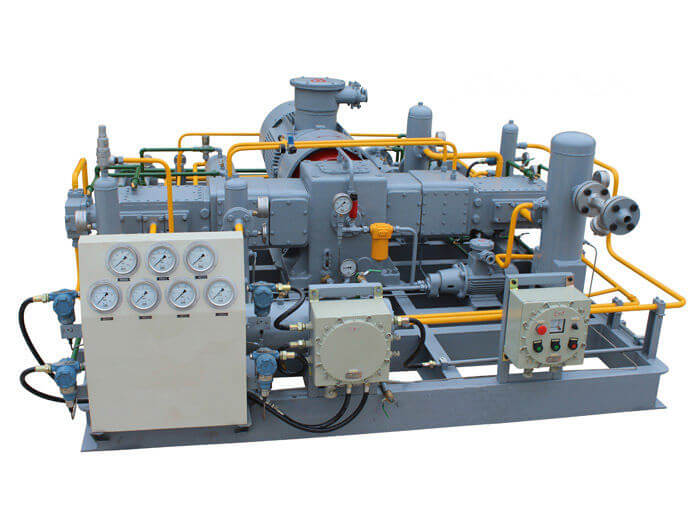
With the increasingly severe global climate change and the urgent need to optimize the energy structure, hydrogen energy, as a zero-carbon emission, highly efficient and convertible secondary energy, is taking center stage on the world energy stage at an unprecedented rate. It can not only be directly burned as a fuel to generate electricity, but also be converted into electricity through fuel cells. Its application scenarios span multiple fields such as industry, transportation, construction and electricity. However, the widespread application of hydrogen energy is not smooth sailing. Its inherent physical properties – extremely low density at room temperature and pressure, bring huge technical challenges to large-scale storage and transportation. It is in this context that the role of hydrogen compressors is particularly critical. It is not just a simple mechanical equipment, but also a core hub connecting the upstream hydrogen production and downstream applications of the hydrogen energy industry chain. By increasing hydrogen density, optimizing storage efficiency and reducing transportation costs, it actually enables the healthy development and popularization of the entire hydrogen energy industry. It can be said that without efficient and reliable hydrogen compression technology, the “ideal” of hydrogen energy will eventually be difficult to become “reality”.
Overview of hydrogen compressors

Hydrogen compressors are a type of mechanical equipment specifically used to pressurize hydrogen. Its core function is to reduce the distance between hydrogen molecules through mechanical energy, thereby increasing the density of hydrogen and allowing it to store more hydrogen in the same volume. According to different working principles, hydrogen compressors can be divided into many types, the common ones include:
Piston compressor: This type of compressor changes the cylinder volume through the reciprocating motion of the piston in the cylinder to achieve the suction, compression and discharge of hydrogen. Piston compressor technology is mature and widely used, but there may be efficiency loss and sealing problems under high pressure ratio.
Diaphragm compressor: Diaphragm compressor compresses gas through the reciprocating motion of a flexible diaphragm. Since the diaphragm completely isolates the gas from the moving parts, it can effectively avoid the contamination of hydrogen by lubricants and ensure the purity of hydrogen. It is particularly suitable for fields such as hydrogen fuel cells with extremely high purity requirements.
Ion liquid compressor: This is an emerging compression technology that uses the incompressibility of ionic liquid to transmit pressure. Ionic liquid has good solubility in hydrogen, can absorb impurities in hydrogen during the compression process, and has good sealing performance, but it is still in the early stages of research and development and commercialization.
Turbine compressor: Turbine compressor continuously compresses hydrogen through a high-speed rotating impeller. This type of compressor has the advantages of large flow and smooth operation, but it is usually suitable for lower compression ratios and has high requirements for bearing seals and materials.
Liquid metal piston compressor: This technology uses liquid metal as a piston, avoiding the friction and wear problems of traditional mechanical pistons and achieving higher compression ratios, but the technology is not yet mature.
Hydrogen compressors need to take special consideration of the physical and chemical properties of hydrogen during design and manufacturing. Hydrogen is the smallest molecule and has extremely strong permeability, which can easily penetrate general sealing materials, so the requirements for sealing technology are extremely high. At the same time, hydrogen is flammable and explosive, so the safety of the compressor is of paramount importance, and explosion-proof design, strict leak detection and fault protection systems are required. In addition, hydrogen generates heat during the compression process, and an efficient heat dissipation system is also the key to ensuring the stable operation of the compressor.
Challenges and needs of hydrogen storage

As an ideal clean energy source, the primary challenge facing the large-scale application of hydrogen is storage. The storage difficulties of hydrogen are mainly reflected in the following aspects:
Extremely low density at room temperature and pressure: At standard atmospheric pressure and 20°C, 1 cubic meter of hydrogen weighs only about 0.09 kg, while the same volume of natural gas weighs about 0.7 kg. This means that to store the same amount of hydrogen, a much larger volume than natural gas or gasoline is required. For example, if a hydrogen fuel cell car directly stores hydrogen at room temperature and pressure, its storage tank will occupy a huge space and is not practical.
Safety and cost of high-pressure storage: In order to increase storage density, the current mainstream storage method is high-pressure gas storage. Common pressure levels are 35 MPa and 70 MPa. Compressing hydrogen to such a high pressure requires strong and expensive tank materials, such as carbon fiber composites, which greatly increases storage costs. At the same time, high-pressure storage also brings certain safety risks, and strict requirements are imposed on the manufacture, testing and use of storage tanks.
Energy consumption of cryogenic liquid storage: Another way to increase storage density is to liquefy hydrogen, and the density of liquid hydrogen is much higher than that of gaseous hydrogen. However, the liquefaction temperature of hydrogen is extremely low, at -253°C, which requires a lot of energy for refrigeration, resulting in high liquefaction costs, and there is still a certain amount of evaporation loss (“boiling evaporation”) during storage and transportation.
Efficiency and technical bottlenecks of solid-state storage: Solid-state storage, such as metal hydride storage, chemical hydride storage, etc., has the potential for high density and safety. However, these technologies currently still face technical bottlenecks in terms of hydrogen absorption and desorption rate, cycle life, operating temperature and cost, and have not yet been commercialized on a large scale.
Weight and volume of hydrogen storage materials: Even for high-pressure gaseous or liquid storage, the weight and volume of the storage tank itself are large, which significantly affects the vehicle’s payload and range in mobile applications (such as automobiles).
In view of the above challenges, the development of hydrogen energy urgently needs efficient, safe and economical hydrogen storage solutions. The core demand is: how to store more hydrogen in a limited space, reduce storage costs, and ensure the safety of the storage process. Hydrogen compressors are the key to solving these needs.
Methods for hydrogen compressors to improve storage efficiency
As a clean and efficient secondary energy source, hydrogen is considered to be an important component of the future energy structure. However, the storage and transportation of hydrogen is one of the main challenges facing its large-scale application. Since hydrogen has an extremely low density at room temperature and pressure, its storage efficiency has become an important factor restricting its development. As a core device, hydrogen compressors significantly improve the storage efficiency of hydrogen by increasing the pressure of hydrogen, laying the foundation for the widespread application of hydrogen energy.
Challenges of hydrogen storage efficiency
Under standard conditions (0°C, 1 atmosphere), 1 cubic meter of hydrogen weighs only about 0.09 kilograms. This means that if atmospheric pressure hydrogen is directly stored, extremely large containers are required to store enough energy, which is not feasible in practical applications, especially in mobile applications such as fuel cell vehicles. In order to solve this problem, improving the storage efficiency of hydrogen becomes the key, and the core idea is to increase the mass of hydrogen per unit volume, that is, to increase the density of hydrogen.
Hydrogen compressor: the core means to improve storage density
Hydrogen compressors significantly increase the pressure of hydrogen by mechanically compressing it, thereby greatly increasing the density of hydrogen. According to the ideal gas law (PV=nRT), the volume of a gas is inversely proportional to its pressure when the temperature remains constant. This means that when the pressure of hydrogen increases, its volume will decrease accordingly, or in other words, more hydrogen molecules can be accommodated in the same volume.
Increase the mass of hydrogen per unit volume: Hydrogen compressors suck in low-pressure hydrogen and gradually compress it, raising its pressure from a few bars to hundreds or even thousands of bars. Taking the common 70 MPa (about 700 bar) high-pressure hydrogen storage as an example, at the same volume, the mass of hydrogen stored is 700 times that at normal pressure. This means that a relatively small storage tank can store enough hydrogen to meet application needs. For example, the hydrogen storage tank of a fuel cell vehicle may only have a volume of tens of liters, but it can store several kilograms of hydrogen and support a range of hundreds of kilometers.
Achieve compact storage: The application of compression technology allows hydrogen to be compactly stored in a limited space. This is crucial for space-constrained application scenarios, such as:
Fuel cell vehicles: Onboard hydrogen storage bottles need to be integrated into the limited vehicle body space, and high-pressure compression is currently the most mature and widely used onboard hydrogen storage method.
Hydrogen refueling stations: Hydrogen refueling stations need to store a large amount of hydrogen to meet vehicle refueling needs, and high-pressure storage tanks can effectively reduce the floor space.
Hydrogen transportation: Whether it is through high-pressure long-tube trailers or future pipeline transportation, compressed hydrogen can significantly increase the single-time transportation volume or transportation efficiency.
The embodiment of compression technology in different application scenarios
Hydrogen refueling stations: Hydrogen refueling stations are the core of hydrogen energy infrastructure. Their main function is to compress and store hydrogen produced or transported, and finally refuel it into fuel cell vehicles. Hydrogen refueling stations are usually equipped with multi-stage compressors to increase the hydrogen pressure from the supply pressure (such as tens of bar) to the pressure required by the on-board storage tank (such as 350 bar or 700 bar) to achieve rapid refueling and improve refueling efficiency.
Industrial hydrogen: In many industrial fields such as chemical, metallurgical, and electronic industries, hydrogen is widely used as a reducing agent, protective gas, or production raw material. These industrial processes often require a stable, high-pressure supply of hydrogen. Hydrogen compressors ensure that hydrogen can be delivered to the production line at the required pressure and flow rate to ensure the continuity and efficiency of production. Through high-pressure storage, companies can reduce the footprint of hydrogen storage facilities and improve the reliability of hydrogen supply.
Energy storage: With the rapid development of renewable energy generation (such as wind and solar energy), the stability of the power grid faces challenges. Excess electricity is produced by electrolyzing water to produce hydrogen, and hydrogen is stored at high pressure. During peak hours of electricity consumption, it can be used to generate electricity through fuel cells to achieve energy storage and reuse. In this “electricity-hydrogen-electricity” recycling mode, hydrogen compressors are an indispensable link, which ensures that hydrogen can be stored efficiently and release energy when needed.
Improve compression efficiency and safety
In order to further improve storage efficiency, in addition to improving the compression ratio, it is also necessary to pay attention to the efficiency and safety of the compression process itself. Efficient hydrogen compressors can reduce energy consumption and reduce operating costs. At the same time, due to the flammable and explosive properties of hydrogen, the design and operation of the compressor must pay great attention to safety, including material selection, sealing technology, explosion-proof measures and intelligent monitoring systems, to ensure the safety and reliability of the entire compression and storage process.
The role of hydrogen compressors in improving transportation efficiency
Hydrogen compressors are not only the key to the storage link, but also play an indispensable role in the hydrogen transportation chain, greatly improving the transportation efficiency of hydrogen:
Economic efficiency of pipeline transportation: For large-scale, long-distance hydrogen transportation, pipeline transportation is considered to be the most cost-effective solution in the future. However, when hydrogen is transported in a pipeline, a certain pressure needs to be maintained to overcome pipeline resistance and ensure sufficient flow. Hydrogen compressors set up booster stations along the pipeline to perform multi-stage compression on hydrogen to compensate for pressure loss and maintain the pressure gradient in the pipeline, thereby achieving long-distance and efficient transportation of hydrogen. This is similar to the compressor station in the natural gas pipeline, which ensures the continuity and economy of transportation. Higher pipeline pressure means that more hydrogen can be transported under the same pipe diameter, thereby reducing the transportation cost per unit of hydrogen.
Capacity improvement of high-pressure cylinder transportation: For medium- and short-distance or decentralized hydrogen transportation, high-pressure cylinder transportation (such as tube bundle trailers) is currently the main means. Hydrogen compressors compress hydrogen into cylinders at 20 MPa, 35 MPa or even higher pressures, and then transport it by truck or train. Compressors increase the density of hydrogen in cylinders, allowing each cylinder to carry more hydrogen, thereby reducing the number of transportation trips and reducing transportation costs. For example, a 70 MPa tube trailer can transport three times more hydrogen than a 20 MPa trailer, greatly improving transportation efficiency.
Implementation of liquid hydrogen transportation: Liquid hydrogen transportation is suitable for large-scale, long-distance transoceanic or cross-regional transportation because liquid hydrogen has the highest energy density. As mentioned earlier, hydrogen compressors are key pre-treatment equipment in the hydrogen liquefaction process. Without efficient compressors, the hydrogen liquefaction process will consume more energy and be less efficient. Therefore, compressors indirectly support the economy and feasibility of liquid hydrogen transportation, allowing large transportation vehicles such as liquid hydrogen ships to efficiently carry and transport liquid hydrogen.
Efficiency of filling and unloading: At the terminal links such as hydrogen refueling stations and industrial hydrogen use points, hydrogen compressors are responsible for compressing the stored hydrogen (whether from pipelines, gas cylinders or liquid hydrogen storage tanks) to the pressure required by users. This includes filling 70 MPa of hydrogen for fuel cell vehicles or supplying hydrogen at a specific pressure for industrial production lines. Efficient compressors can achieve fast filling and unloading, shorten hydrogen refueling time, and improve equipment turnover, thereby improving the efficiency of the entire hydrogen supply chain.
Flexibility to cope with different pressure requirements: Hydrogen may be at different pressure levels in various links of production, storage, transportation and application. For example, hydrogen produced by water electrolysis may only be a few MPa, while fuel cell vehicles require 70 MPa. Hydrogen compressors can flexibly adjust the output pressure according to the pressure requirements of upstream and downstream links, playing the role of “pressure converters”, allowing hydrogen to flow smoothly between different pressure systems, thereby improving the adaptability and efficiency of the entire hydrogen supply chain.
Conclusion
Hydrogen compressors play a pivotal role in the hydrogen energy industry chain and are the key hub connecting various links of hydrogen production, storage, transportation and application. By efficiently pressurizing hydrogen, it greatly improves the storage density of hydrogen, allowing limited space to carry more hydrogen, thereby reducing the volume and cost of storage equipment. At the same time, hydrogen compressors are also the key technical support for long-distance pipeline transportation, high-pressure cylinder transportation and liquid hydrogen transportation of hydrogen, significantly improving the transportation efficiency and economy of hydrogen.
Looking to the future, with the rapid development of the hydrogen energy industry and the continuous advancement of technology, hydrogen compressors will develop in a more efficient, safer and smarter direction. For example, emerging technologies such as magnetic levitation compressors and oil-free compressors will further improve the energy efficiency and reliability of compressors. Breakthroughs in materials science will bring compressor components that are more corrosion-resistant and more resistant to hydrogen embrittlement. Intelligent control systems will realize remote monitoring, fault diagnosis and predictive maintenance of compressors to ensure the stable operation of the hydrogen supply chain.
It can be said that without the core support of hydrogen compressors, the large-scale commercial application of hydrogen energy will be difficult to achieve. It is a key technology to enable the hydrogen energy era and a “behind-the-scenes hero” that drives hydrogen energy from vision to reality. As the global demand for clean energy grows, the importance of hydrogen compressors will become more prominent. It will grow together with the entire hydrogen energy industry and contribute to building a sustainable future.
Request a Quick Quote Now

Shanghai Sollant Energy Saving Technology Co., Ltd.
Drawing on our years of experience and expertise in air separation and PSA technologies, we deliver customized solutions tailored to your specific needs.
