
Psa Oxygen Generator
Based on the principle of pressure swing adsorption, high-quality zeolite is used as the adsorbent. Under a certain pressure, due to the kinetic effect, the diffusion rates of oxygen and nitrogen on carbon molecules are quite different. The nitrogen molecules are adsorbed by zeolite in large quantities, and the oxygen molecules are enriched in the gas phase to achieve oxygen and nitrogen separation.
- Purity: 93%±3%
- Oxygen volume: 1~2000Nm3/h
- Pressure: 0-5.5bar
- Dew point: -40℃

Psa Oxygen Generator Advantages
Oxygen concentrators are ideal for companies that require long-term, large-volume oxygen supply and value cost-effectiveness and environmental protection.
Continuous gas supply
Strong stability: The oxygen concentrator can supply oxygen 24 hours a day, ensuring the continuous operation of the production line without being affected by the replacement of oxygen cylinders or supply interruptions. Adjustable gas supply: Adjust oxygen production according to actual needs to avoid overproduction or shortages and improve production flexibility.
Stable equipment
Easy operation: Modern oxygen concentrators are well designed, easy to operate and maintain, and can operate stably for a long time with less downtime. Efficient management: Through the automated control system, oxygen purity and output are monitored in real time to ensure the efficiency and stability of the production process.
Cost-effectiveness
Low long-term costs: Despite the higher initial investment, the oxygen concentrator can continuously produce oxygen, avoiding the cost of frequent purchases of oxygen cylinders, which is more cost-effective in the long run. Reduced transportation costs: On-site oxygen generation reduces the cost of transporting and storing oxygen cylinders, reducing overall operating costs.
Environmental protection
Reduce carbon emissions: On-site oxygen generation reduces the carbon footprint of transporting nitrogen and oxygen cylinders, helping companies achieve their environmental goals.
| Model | Flow(m³/hr) | Purity (%) | Pressure(Mpa) | High pressure (Mpa) | Power source | Craft | Dew point(℃) | Low dew point (℃) |
|---|---|---|---|---|---|---|---|---|
| SLTOG-10 | 10 | ≥93±3 | ≤0.4-0.5 | 1-20 | Air | Pressure Swing Adsorption | -45 | -70 |
| SLTOG-15 | 15 | ≥93±3 | ≤0.4-0.5 | 1-20 | -45 | -70 | ||
| SLTOG-20 | 20 | ≥93±3 | ≤0.4-0.5 | 1-20 | -45 | -70 | ||
| SLTOG-30 | 30 | ≥93±3 | ≤0.4-0.5 | 1-20 | -45 | -70 | ||
| SLTOG-40 | 40 | ≥93±3 | ≤0.4-0.5 | 1-20 | -45 | -70 | ||
| SLTOG-50 | 50 | ≥93±3 | ≤0.4-0.5 | 1-20 | -45 | -70 | ||
| SLTOG-60 | 60 | ≥93±3 | ≤0.4-0.5 | 1-20 | -45 | -70 | ||
| SLTOG-70 | 70 | ≥93±3 | ≤0.4-0.5 | 1-20 | -45 | -70 | ||
| SLTOG-80 | 80 | ≥93±3 | ≤0.4-0.5 | 1-20 | -45 | -70 | ||
| SLTOG-100 | 100 | ≥93±3 | ≤0.4-0.5 | 1-20 | -45 | -70 | ||
| SLTOG-200 | 200 | ≥93±3 | ≤0.4-0.5 | 1-20 | -45 | -70 |
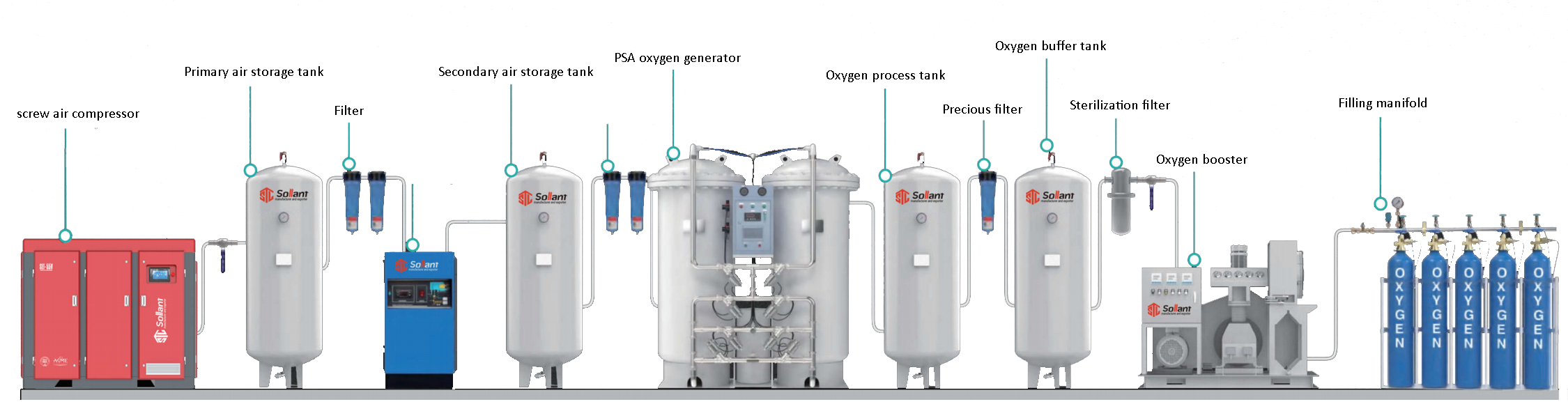
Air compressor: Air is sucked in from the environment and compressed to a higher pressure by a compressor. The compressed air usually has a higher temperature and pressure
Cooler: The compressed high-temperature air passes through the cooler to reduce the air temperature. The cooled air is usually cooled by an air cooler or cooling tower to remove some of the heat.
Drying tower: In some systems, the dehumidified air will pass through a drying tower (such as a molecular sieve dryer) to further remove the remaining moisture and other impurities to ensure that the air is dry enough to improve the purity and quality of the nitrogen.
PSA (Pressure Swing Adsorption): In the PSA system, the dried compressed air passes through the adsorption tower and passes through the molecular sieve medium. The nitrogen is retained on the adsorbent, while oxygen and other gases are discharged. High-purity nitrogen is obtained through periodic pressure changes and adsorbent regeneration.
Gas storage tank: The separated nitrogen is stored in the gas storage tank for subsequent use. The gas storage tank can be a high-pressure gas cylinder or a large gas storage tank, depending on the demand for nitrogen.
Control system: The entire nitrogen production system is equipped with a control system to monitor the operating status of each stage, including air pressure, temperature, nitrogen purity, etc. The control system can automatically adjust operating parameters, optimize system performance, and provide fault alarms and maintenance reminders.
Through the above process, the nitrogen production system can efficiently extract nitrogen from the air to meet the needs of different applications
Application Industry
The main advantage of liquid nitrogen is that its extremely low temperatures provide excellent cooling capabilities, significantly improving the efficiency and effectiveness of various industrial and scientific processes. It can quickly freeze and process materials, enhance the durability of equipment and tools, optimize the production process, and ensure high efficiency and stability during storage and processing.
Blast furnace steelmaking:
In the blast furnace steelmaking process, oxygen is used in oxygen injection technology. By injecting oxygen directly into the blast furnace, the combustion efficiency is greatly improved, which reduces the consumption of fuels (such as coke) and improves the output and quality of molten iron. Oxygen injection technology not only improves production efficiency, but also reduces production costs.
Oxygen converter steelmaking:
In the oxygen converter steelmaking process, oxygen is blown directly into the molten iron to remove impurities such as carbon and sulfur, thereby producing high-quality steel. Compared with traditional steelmaking methods, this process has a faster reaction speed, lower energy consumption, and less pollution to the environment.
Oxidation reactions:
In the chemical industry, oxygen is widely used in various oxidation reactions, such as the production of ethylene oxide (used to make antifreeze), formaldehyde (used to make resins and adhesives), and nitric acid (used in fertilizers and explosives). These reactions require high-purity oxygen to ensure the efficiency of the reaction and the purity of the product.
Synthetic ammonia:
In the synthesis of ammonia, oxygen is used to provide the required energy for nitrogen to synthesize ammonia (NH3). Synthetic ammonia is an important raw material for the manufacture of fertilizers. Oxygen helps increase production and reduce costs by providing the energy required for the reaction.
Wastewater treatment:
In sewage treatment plants, oxygen is used in the aeration process of the activated sludge process. By increasing the dissolved oxygen in the water, the decomposition of organic pollutants by microorganisms is promoted, thereby improving the efficiency of sewage treatment. This method can effectively reduce the content of organic matter, prevent eutrophication of water bodies, and protect the ecological environment.
Aquaculture:
In aquaculture, oxygen is used to maintain the dissolved oxygen content in the water to ensure the healthy growth of fish and other aquatic organisms. Through oxygenation equipment, oxygen is dissolved into the water to prevent the death of aquatic organisms due to lack of oxygen, which is particularly important for intensive aquaculture.
Combustion aid:
During the glass manufacturing process, oxygen is used in the combustion system to increase the temperature in the furnace and enhance the efficiency of glass melting. Oxygen-enriched combustion technology can improve combustion efficiency, reduce fuel consumption, and improve product quality.
Emission control:
By using oxy-combustion technology, nitrogen oxide (NOx) emissions are significantly reduced during the glass manufacturing process. This technology reduces environmental pollution and complies with increasingly stringent environmental regulations.
Semiconductor Manufacturing:
In semiconductor manufacturing, oxygen is used in chemical vapor deposition (CVD) and thermal oxidation processes. The formation of the oxide layer is critical to the manufacture of high-performance integrated circuits (ICs). The high purity of oxygen ensures the uniformity and stability of the oxide layer, thereby ensuring the performance and life of the chip.
Flat Panel Displays:
In the production of liquid crystal displays (LCDs) and organic light-emitting diodes (OLEDs), oxygen is used in thin film deposition and etching processes in the production process. These processes require extremely high purity oxygen to ensure the high quality and stability of the display.
Rocket Propulsion:
In the aerospace industry, liquid oxygen (LOX) is the primary oxidizer in rocket propulsion systems. Liquid oxygen is mixed with liquid hydrogen or other fuels to generate the tremendous thrust that propels rockets into space. The high-density energy and stability of liquid oxygen make it an indispensable part of rocket propulsion systems.
Aircraft Manufacturing:
During the manufacturing of aircraft, oxygen is used in various processes such as cutting and welding. High-purity oxygen ensures the precision and safety of these processes, especially when it comes to the processing of high-strength materials such as titanium and aluminum.
Freshness preservation and packaging:
In food packaging, oxygen is used in modified atmosphere packaging (MAP) technology. By controlling the oxygen content inside the package, the shelf life of fresh food can be extended and food spoilage can be prevented. Oxygen is particularly important in the packaging of perishable foods such as meat, dairy products, fruits and vegetables.
Beverage manufacturing:
In the production of carbonated beverages, oxygen is used in water treatment and carbonation. High-purity oxygen ensures the control of sanitary conditions during beverage production and helps improve the taste and quality of beverages.
Bleaching process:
The application of oxygen equipment in the paper industry includes oxygen bleaching process. Compared with traditional chlorine bleaching methods, oxygen bleaching is an environmentally friendly technology that reduces the emission of toxic chlorides and can effectively improve the whiteness and strength of pulp.
Delignification:
In pulp production, oxygen is used in the delignification process to remove lignin from wood fibers. After removing lignin, the quality of pulp is improved, the strength and whiteness of paper are increased, and the negative impact on the environment during the production process is greatly reduced.
