
What to do if the natural gas compressor is noisy?
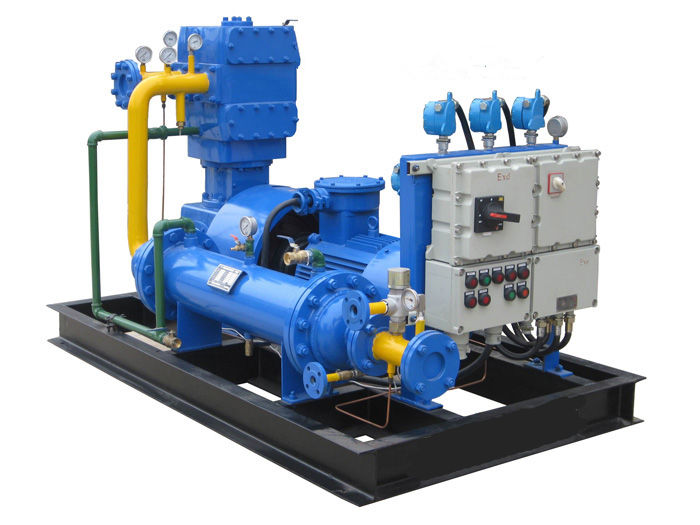
In the process of modern industrialization, natural gas compressors, with their pivotal position, widely support key areas such as petrochemicals, natural gas transportation, energy storage, and various industrial gas applications. They are the core hubs that drive production and provide power. However, behind this efficient operation, an increasingly serious problem that cannot be ignored has surfaced-high-intensity operating noise. This noise not only directly threatens the hearing health of front-line operators and causes occupational disease risks, but is also likely to seriously interfere with the working environment and reduce production efficiency. At the same time, high-decibel noise is also very likely to cause trouble to the lives of surrounding residents, cause environmental complaints, and even affect corporate image and social harmony. Therefore, how to systematically and efficiently control and reduce the noise generated by natural gas compressors is no longer an optional option, but an urgent and strategic engineering topic in the development of modern industrial civilization. This article will take a rigorous perspective to deeply analyze the diversified sources of natural gas compressor noise, elaborate on a series of proven basic methods of noise control, and explore and look forward to the world’s leading noise reduction technologies and innovative solutions with forward-looking thinking. We aim to provide a comprehensive, in-depth and operational authoritative guide for noise optimization of natural gas compressors, helping enterprises to achieve both environmental protection and efficiency.
Causes of noise from natural gas compressors
The noise generated by natural gas compressors does not come from a single source, but is a complex result of the interweaving of multiple physical effects such as mechanical, pneumatic, and even electromagnetic. Accurately identifying and understanding the root causes of these noises is the cornerstone of formulating any effective noise reduction strategy.
Mechanical noise:
Imbalance and vibration of moving parts: The compressor is full of high-speed or high-frequency moving parts. Taking a reciprocating compressor as an example, if there is a slight mass imbalance or deformation in the high-speed reciprocating motion of the piston, connecting rod, and crankshaft, significant inertial force and torque will be generated, resulting in periodic vibration of the entire body. In centrifugal or axial compressors, if the dynamic balancing accuracy of the high-speed rotating rotor and impeller is insufficient, huge centrifugal force will be generated during the rotation process, which will cause strong vibration of the shaft system. This vibration is transmitted to the outside through structures such as bearing seats and bases, and propagates in the form of structural noise and radiation noise. These vibrations not only directly produce low-frequency roars or high-frequency sharp sounds, but also stimulate the resonance of adjacent components, further amplifying the noise.
Wear and looseness of components: Long-term high-load operation inevitably leads to mechanical wear of components. After the raceway, ball or cage of the bearing is worn, its internal clearance will increase, resulting in irregular movement trajectory of the components, producing rustling, creaking or knocking sounds. If the tooth surface of the gear transmission mechanism is worn or the gear meshing accuracy is reduced, impact, sliding and friction will be generated during the meshing process, emitting a harsh whistle or click. Wear or spring fatigue of the valve plate and valve seat of the valve (especially the intake and exhaust valves of reciprocating compressors) will cause the valve to close loosely or open unsmoothly, resulting in a hissing sound of airflow leakage or a flapping sound of valve flutter. In addition, the loosening of fasteners such as bolts and nuts will also cause relative movement and impact noise between components. These noises caused by wear and looseness are not only a signal of reduced equipment performance, but also a precursor to potential failures.
Mechanical friction: Dry friction or boundary friction will occur between the moving surfaces inside the machine, such as the piston ring and the cylinder wall, the journal and the bearing bushing, if there is insufficient lubrication, lubricant failure or lubrication system failure. This friction will produce high-frequency squeaking or whistling sounds, accompanied by a large amount of heat generation, accelerating component wear. In addition, some non-contact seals (such as labyrinth seals) may also produce friction noise if they are improperly designed or installed. Insufficient interference or accumulation of dimensional tolerances during the assembly process of parts may also cause unnecessary friction noise.
Pneumatic noise:
Intake and exhaust pulsation: This is one of the main noise sources unique to compressors. Whether it is the periodic intake and exhaust of a reciprocating compressor, or the surge or rotational stall of a centrifugal compressor under non-design conditions, periodic pressure fluctuations, i.e. sound waves, will be formed in the intake duct, compression chamber and exhaust duct. These pressure waves propagate in the pipeline and radiate out in the form of sound energy at the open end of the pipeline (such as the intake port, exhaust port) or at the pipeline elbow, valve, etc. The intensity of pulsation noise is closely related to air flow velocity, changes in pipeline cross-section, pipeline length and shape. Especially when resonance occurs in the pipeline, the noise intensity will be sharply amplified, manifested as low-frequency humming or high-frequency whistling.
Airflow turbulence and eddy current: When high-speed gas flows through pipelines, elbows, valves, throttle holes, and blades, diffusers and other components inside the compressor, irregular eddy currents and turbulence will be generated due to sudden changes in air flow velocity, sudden changes in flow channel cross-section or the presence of obstacles. These turbulent effects cause the dissipation of internal energy of the airflow and are converted into broadband noise, usually manifested as a “hissing” sound of air flow or a “whistling” sound. For example, the air filtration system at the inlet of the compressor, the airflow impact between the internal blades and the diffuser, and the throttling of the valve in the exhaust pipeline may all produce significant turbulent noise.
Jet noise: When the compressor is under abnormal operating conditions such as the safety valve opening to release pressure, the vent valve exhausting or the pipeline rupture, high-pressure gas is ejected into the atmosphere through small holes, gaps or nozzles at high speed, which will form a strong jet noise. This type of noise is characterized by extremely high sound pressure level, wide sound spectrum, and obvious impact. The intensity of the injection noise is closely related to the injection speed, pressure difference and injection port shape.
Electromagnetic noise (for electric compressors):
Motor vibration: The motor that drives the natural gas compressor will generate a changing electromagnetic field in its internal stator winding when the AC current passes through it. This electromagnetic field acts on the rotor and stator core to generate periodic electromagnetic force. These electromagnetic forces will cause mechanical vibrations in the stator, rotor and casing. If the frequency of the electromagnetic force is close to the inherent mechanical frequency or basic resonance frequency of the motor, resonance will occur, resulting in a sharp increase in vibration and noise. This noise usually manifests as a “buzzing” sound.
Electromagnetic whistling: When the silicon steel sheets of the motor are not tightly stacked, the windings are loose, or due to magnetic flux distortion, harmonic current, etc., high-frequency magnetostrictive effects or electromagnetic oscillations may be generated, resulting in a harsh “whistling” sound. The frequency of this noise is usually high and has strong penetration.
Basic methods for noise reduction of natural gas compressors
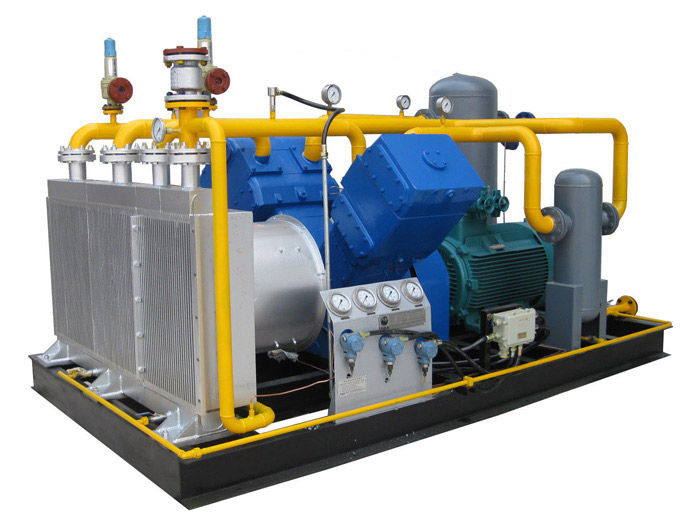
For the above-mentioned diversified noise sources, effective noise reduction strategies must be multi-pronged and comprehensive. Basic noise reduction methods usually follow the principle of “sound source control-transmission path blocking-receptor protection”.
Sound source control: This is the most fundamental and economical noise reduction strategy, which aims to intervene at the source of noise generation.
Optimized design and high-precision manufacturing: The concept of noise control should be introduced from the compressor research and development stage. For example, the aerodynamic shape of the impeller and diffuser is optimized to reduce airflow impact and separation; the valve structure is improved to reduce the opening and closing noise; the moving parts of the reciprocating compressor are precisely designed for dynamic balancing to minimize the inertia moment. During the manufacturing process, high-precision processing technology is used to ensure that the dimensional tolerance and form and position tolerance of the components meet the design requirements, such as the grinding of gears and the precise assembly of bearings. These refined designs and manufacturing can fundamentally improve the smoothness of equipment operation and reduce noise.
Selection of low-noise equipment and components: When purchasing equipment, compressor products with lower noise levels under the same performance parameters should be given priority. Many well-known compressor manufacturers will clearly mark the noise level in the product manual, and even provide noise-reducing products. In addition, the noise characteristics of the motors, cooling fans, gearboxes and other components used in conjunction should also be considered, and products with silent or low-noise designs should be selected.
Strict installation and commissioning: The correct installation of the equipment is crucial to noise control. Ensure that the equipment foundation is flat and firm, and there is no rigid connection with the surrounding structure to avoid “short-circuit” vibration transmission. During the installation process, the centering, alignment and tightening should be carried out strictly in accordance with the manufacturer’s specifications to ensure that the gaps between the components are reasonable and the connections are reliable. Comprehensive vibration and noise tests should be carried out during the commissioning phase to promptly detect and correct installation deviations or potential problems.
Regular maintenance and care: Implementing preventive maintenance is the key to reducing noise. This includes but is not limited to:
Tightening inspection: Regularly check whether all bolts, nuts and other fasteners are loose, tighten them in time to prevent impact and vibration noise caused by looseness.
Lubrication management: Ensure that all moving parts such as bearings, gears, crankshafts, etc. are fully and cleanly lubricated. Regularly check the quality and oil level of lubricating oil, replace or replenish it in time to prevent dry friction noise and component wear caused by poor lubrication.
Component replacement: Establish a sound component wear monitoring mechanism, and replace bearings, gears, seals, valve plates, etc. that are worn beyond the standard in time to avoid abnormal noise caused by the decline of component performance.
Cleaning and maintenance: Regularly clean the air intake filter, cooler, etc. to prevent blockage from affecting the airflow and increasing aerodynamic noise.
Propagation path blocking: When the sound source control cannot fully meet the requirements, physical barriers are needed to prevent the propagation of noise.
Soundproof enclosure/soundproof room: This is one of the most common and effective noise reduction measures in the industrial field. The soundproof enclosure is usually made of multiple layers of composite materials. The outer layer is a high-density soundproof material (such as steel plate, thick wood board, concrete), which can effectively reflect and block the penetration of sound waves; the inner layer is paved with porous sound-absorbing materials (such as glass fiber wool, mineral wool board, perforated sound-absorbing board, polyester fiber sound-absorbing cotton, etc.), which are used to absorb the noise entering the enclosure, reduce the multiple reflections and reverberation of sound waves in the enclosure, thereby reducing the sound energy inside the enclosure and reducing the outward transmission noise. When designing a soundproof enclosure, it is necessary to consider the heat dissipation requirements of the equipment and set up necessary vents and exhaust systems, but these openings must also be acoustically treated, such as installing silencer shutters or silencers. At the same time, inspection doors, observation windows, and cable and pipe perforations need to be strictly sealed to prevent “sound leakage”.
Sound absorption treatment: High-efficiency sound-absorbing materials can be laid on a large area on the inner walls, ceilings, and even the ground of the compressor room or workshop. These materials have a large number of connected or unconnected tiny pores inside. When sound waves enter these pores, they will rub against the air and materials, converting sound energy into heat energy and thus being absorbed. Sound absorption treatment can effectively reduce the reverberation time of indoor noise, make the hearing experience more comfortable, and reduce the overall noise level. Commonly used sound-absorbing materials include sound-absorbing cotton, sound-absorbing panels, space sound absorbers, etc.
Sound insulation barrier: When it is impossible to build a complete soundproof cover or soundproof room, a sound insulation barrier can be set between the noise source and the protected area. The sound insulation barrier achieves the purpose of noise reduction by blocking the linear propagation of sound waves. Its noise reduction effect mainly depends on the height, length and size of the sound shadow area of the barrier. For diffracted sound waves, its effect is limited and is mainly suitable for local noise reduction in open or semi-open spaces.
Elastic support and flexible connection: Vibration is one of the sources of noise. In order to prevent equipment vibration from being transmitted to the building foundation or other equipment through the structure, elastic support should be used, such as installing rubber vibration damping pads, spring dampers, air spring dampers, etc. These vibration dampers can effectively isolate the vibration of the equipment and prevent it from propagating downstream, thereby reducing structural noise and secondary radiation noise. At the same time, flexible connectors (such as rubber hoses, bellows, expansion joints) should be used at the connection between the compressor and the intake and exhaust pipes, cooling water pipes, power cables, etc. to avoid rigid connections that directly transmit the vibration of the equipment to the entire pipeline system, causing pipeline resonance and radiation noise.
Noise elimination: Specially for the treatment of airflow noise.
Intake and exhaust silencers: This is the most direct and effective way to deal with aerodynamic noise. There are many types of silencers, which should be selected according to the spectral characteristics of the noise, airflow parameters and noise reduction requirements:
Resistive silencer: The internal filling of sound-absorbing materials absorbs sound energy through the sound-absorbing materials. It is suitable for dealing with broadband noise, especially for high-frequency noise.
Resistant silencer: Using structures such as pipe cross-section changes, resonance chambers, expansion chambers, etc., the sound energy is attenuated through the reflection, interference and standing wave effects of sound waves, mainly for medium and low frequency noise.
Composite silencer: Combining the principles of resistance and resistance, taking into account broadband noise reduction.
Micro-perforated plate muffler: It uses the resonance sound absorption principle of the micro-perforated structure within a specific frequency range. It has the advantages of compact structure, high temperature resistance, and corrosion resistance. It is often used in high temperature and high-speed airflow situations.
When choosing a muffler, in addition to considering the noise reduction effect, you also need to pay attention to its airflow resistance (pressure drop) to avoid excessive impact on the performance of the compressor.
Advanced noise reduction technology and innovative methods
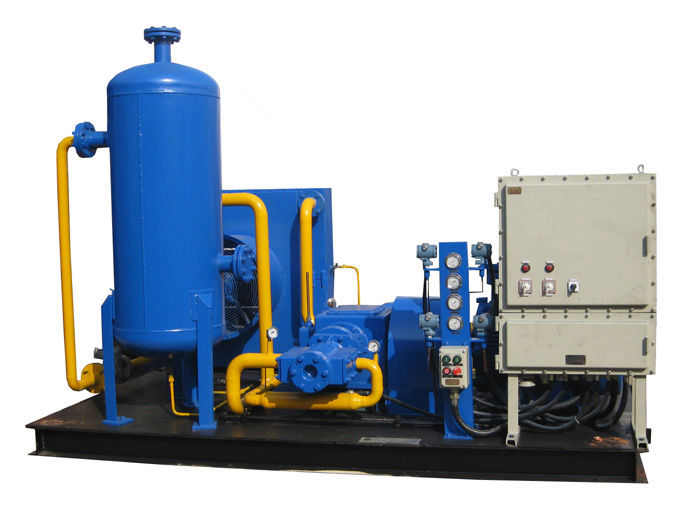 With the rapid development of science and technology, more intelligent, efficient and refined solutions are constantly emerging in the field of natural gas compressor noise reduction.
Active Noise Control (ANC):
Principle and application: Active noise reduction technology is completely different from traditional passive noise reduction. It monitors the noise signal in real time and generates a “reverse sound wave” with the same waveform and opposite phase as the original noise through a digital signal processor (DSP), and then plays it out through a speaker to make the two superimposed and offset, thereby achieving the purpose of noise reduction. ANC has significant advantages in the control of low-frequency noise (usually below 500 Hz) because the wavelength of low-frequency noise is longer and easier to be accurately predicted and offset. In the field of natural gas compressors, ANC can be applied to the low-frequency vibration noise control of large intake and exhaust ducts, cooling fan outlets or specific large equipment bodies. For example, installing an ANC system in the intake duct can effectively eliminate the low-frequency roar caused by air flow pulsation.
Challenges and prospects: Although ANC technology has broad prospects, its complexity, high requirements for system response speed, and limited high-frequency noise processing capabilities are still challenges that need to be overcome. However, with the improvement of computing power and the optimization of algorithms, the application of ANC in specific industrial scenarios will become more and more extensive.
New sound absorption and sound insulation materials:
Nanoporous materials: The nano-level pore structure gives the material an extremely high specific surface area and porosity, which can absorb sound energy more efficiently, and often has thinner, lighter, and more environmentally friendly characteristics, such as nanofiber sound-absorbing felt, aerogel, etc., which have advantages in occasions where space is limited or there are strict requirements on weight.
Intelligent sound-absorbing materials/tunable sound-absorbing structures: This type of material or structure can dynamically adjust its sound absorption performance by changing its own physical properties (such as porosity, resonance frequency) according to changes in the external environment (such as noise frequency, temperature, humidity). For example, some deformable microstructure materials can control their shape through external electric or magnetic fields, thereby changing their absorption capacity for sound waves of a specific frequency and achieving “noise reduction on demand”.
Acoustic metamaterials: Acoustic metamaterials have been a hot topic in the field of acoustics in recent years. They are not made of traditional materials, but through sophisticated microstructure design, they show special acoustic properties that natural materials do not have, such as negative density, negative modulus, negative refractive index, etc. Using these properties, acoustic metamaterials can achieve functions such as complete absorption of sound waves, stealth (sound wave bypass), one-way transmission and even sound focusing. For example, ultra-thin metamaterial sound-absorbing panels with extremely high absorption efficiency for noise of specific frequencies can be designed, or acoustic lenses that can guide noise energy away from sensitive areas can be designed. These technologies are still in the laboratory stage, but they are expected to subvert traditional noise reduction ideas in the future.
Structural acoustic optimization and simulation technology:
Finite element analysis (FEA) and boundary element analysis (BEM): Modern engineering design is inseparable from advanced computer-aided engineering (CAE) tools. FEA is used to analyze the vibration characteristics of equipment structures. By building a detailed three-dimensional model, it simulates the stress, strain and modal vibration of components under operating conditions, so that potential resonance points and high vibration areas can be identified in the design stage, and vibration can be avoided or reduced through structural optimization (such as increasing stiffness, changing mass distribution, and adding damping materials). BEM focuses on sound field analysis, which can predict the propagation path, radiation characteristics and sound pressure distribution of noise in complex spaces, and provide a scientific basis for the optimal layout and parameter selection of sound insulation covers, sound absorbing materials and mufflers. These simulation tools greatly shorten the design cycle and reduce the cost of physical prototype testing.
Topology optimization: This is a more advanced design optimization method. Through algorithm iteration, the optimal material distribution and structural shape are automatically generated under the premise of meeting given performance constraints (such as strength, stiffness, and minimum vibration). For noise-sensitive components, topology optimization can be performed with the goal of minimizing radiated noise or minimizing vibration, so as to achieve structural noise suppression while maintaining functionality.
Intelligent monitoring and fault diagnosis:
Internet of Things (IoT) and multi-sensor fusion: Deploy high-precision vibration sensors, sound pressure sensors, temperature sensors, pressure sensors, etc. at key parts of natural gas compressors (such as bearing seats, motor housings, pipelines, inlet and outlet ports). These sensors collect equipment operation data in real time and continuously through the IoT network, and upload the data to the cloud or local server.
Big data analysis and artificial intelligence (AI): Combined with artificial intelligence algorithms such as machine learning and deep learning, massive sensor data is analyzed and mined. The AI model can learn the normal operating mode of the equipment. Once abnormal noise or vibration mode occurs, the system can identify and issue an early warning in time. For example, by analyzing the changes in the noise spectrum characteristics, it is possible to accurately determine whether it is a specific fault such as bearing wear, poor gear meshing, valve leakage or surge. This predictive maintenance can not only avoid equipment downtime and production losses caused by sudden failures, but more importantly, it can intervene in the early stage of the failure and before the noise has significantly deteriorated, thereby killing the noise problem in its infancy.
Remote diagnosis and expert system: With the help of cloud computing and remote communication technology, experts can remotely access the real-time data and diagnostic reports of equipment, remotely evaluate and diagnose noise problems, and provide professional solutions and maintenance suggestions. This intelligent management mode greatly improves maintenance efficiency and reduces operation and maintenance costs.
Conclusion
The noise control of natural gas compressors is a systematic project involving multiple disciplines and technologies. It requires us not only to have a deep understanding of the physical nature and generation mechanism of noise, but also to be good at using cutting-edge knowledge in multiple fields such as engineering, materials science, and information technology. By actively integrating traditional and effective means such as sound source control, propagation path blocking, and noise reduction and vibration reduction in the entire life cycle of equipment design, manufacturing, installation, operation and maintenance, and boldly introducing innovative technologies such as active noise reduction, new acoustic materials, structural acoustic simulation, and intelligent diagnosis based on the Internet of Things and artificial intelligence, we can build a multi-level and comprehensive noise reduction system.
Looking to the future, with the advancement of Industry 4.0 and smart factories, the noise control of natural gas compressors will tend to be more refined, intelligent, and predictive. Continuous investment in technology research and development and cross-field cooperation will be the core driving force for the sustainable development of the natural gas compressor industry. The ultimate goal is not only to meet the increasingly stringent environmental regulations, but also to create a new industrial production paradigm that is more friendly to operators, more harmonious to the surrounding environment, and more efficient for corporate operations. Achieving the harmonious unity of economic and environmental benefits will be the ultimate value of the natural gas compressor noise reduction optimization solution.
Request a Quick Quote Now

Shanghai Sollant Energy Saving Technology Co., Ltd.
Drawing on our years of experience and expertise in air separation and PSA technologies, we deliver customized solutions tailored to your specific needs.
